1099 vs W-2 Workers: The Real Cost Difference (With 2026 Numbers)
Last spring, I watched a friend—let's call her Maria—nearly sink her six-figure consulting practice because she hired a graphic designer on a 1099, but treated her like a full-time employee. Maria set the designer's hours, supplied her laptop, and micromanaged every revision. Six months later, the designer filed a worker classification complaint with the California Labor Commissioner. Maria got hit with a $14,000 back-tax bill, plus legal fees, plus a fine that ate her entire year's profit margin. That's the real cost of guessing wrong on the 1099 vs W-2 decision. In 2026, with inflation still squeezing margins and the IRS ramping up audit scrutiny, that guess can cost you a lot more than you'd expect. This article walks you through the actual numbers—2026 tax rates, benefits loads, and hidden risks—so you can make the call with your eyes open.
I've been on both sides of this equation: as a small business owner who's classified dozens of workers, and as a freelancer who's been misclassified myself. The difference isn't just about taxes—it's about control, risk, and the kind of relationship you want with the people who do your work. Here's the math that most articles skip.
The Hard Numbers: What You Actually Pay for a W-2 Employee in 2026
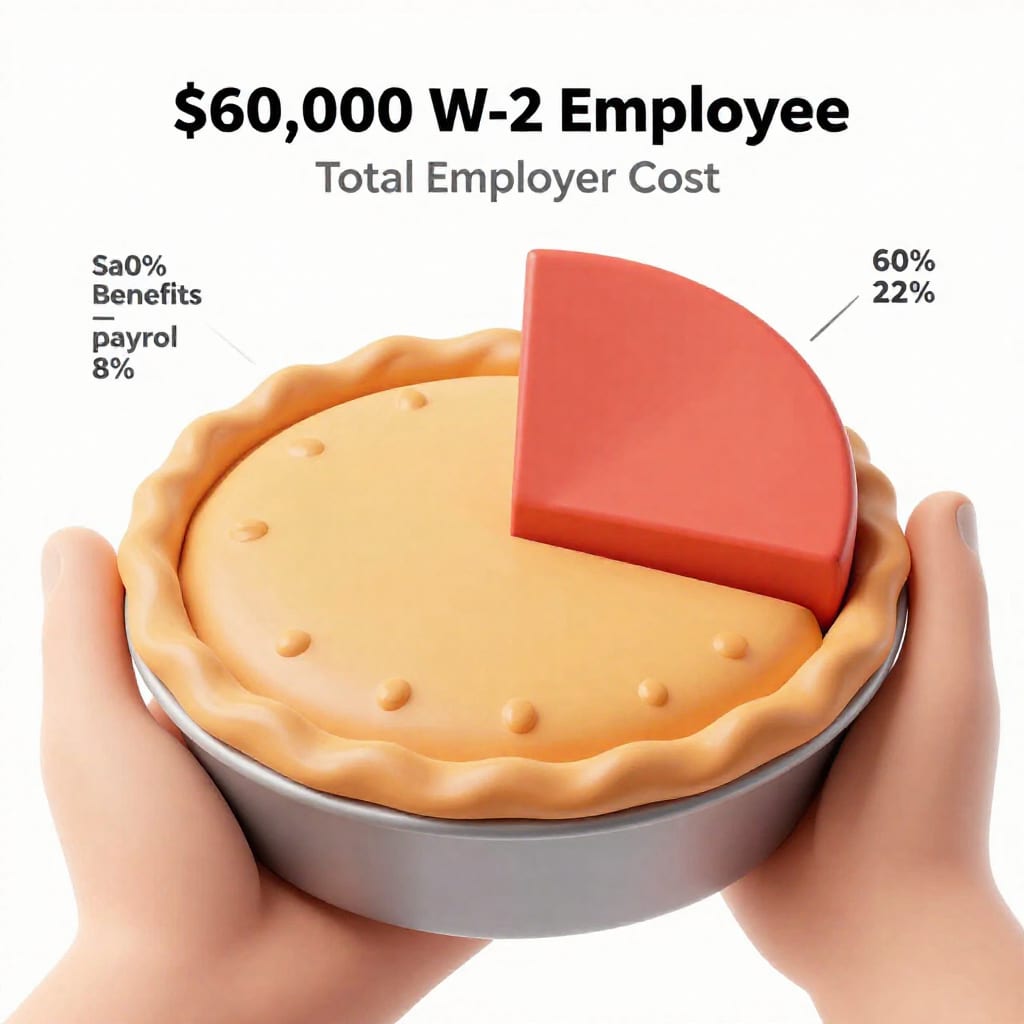
Let's start with the concrete. Say you want to hire a full-time marketing coordinator in 2026. You agree on a base salary of $60,000. That's not the real cost. By the time you add up payroll taxes, mandatory insurance, and the benefits that make you competitive as an employer, your actual outlay is closer to $78,000–$84,000. Here's the breakdown.
Payroll Taxes: The 7.65% You Can't Escape
First, the unavoidable: FICA (Social Security and Medicare). In 2026, the Social Security portion is 6.2% on wages up to $176,100 (that's the 2025 threshold, adjusted annually—for 2026, expect roughly $180,000). Medicare is 1.45% with no cap. That's 7.65% of the first $60,000, or $4,590. Then there's FUTA (Federal Unemployment Tax) at 6% on the first $7,000 of wages, though you usually get a credit down to 0.6% if you pay state unemployment taxes on time. That's $42. SUTA (State Unemployment Tax) varies wildly—in my home state of Texas, it's about 2.7% on the first $9,000, or $243. In California, it can be 6.2% on the first $7,000, or $434. Total payroll taxes for that $60,000 employee: roughly $4,875 to $5,066.
The Hidden 30%: Benefits, Workers' Comp, and Compliance
Here's where the real cost lives. Benefits aren't optional if you want to attract decent talent. Health insurance for a single employee in 2026 runs about $600–$800 per month for a decent PPO plan. That's $7,200–$9,600 a year. If you offer a 401(k) match of 3–5% of salary, add $1,800–$3,000. Paid time off—two weeks vacation plus sick days—costs you 8–10% of salary in lost productivity or replacement coverage, but you're paying the same salary regardless. Workers' compensation insurance: for a marketing coordinator in a low-risk office role, figure $0.50–$1.50 per $100 of payroll, or $300–$900 a year. Then there's compliance overhead: payroll software ($50–$100 per month), HR legal fees for handbook updates, and the time you spend dealing with time-off requests and performance reviews. Call it $1,200–$2,400 annually. Add it all up: benefits and compliance can easily add 30–40% on top of salary. For our $60,000 employee, that's $18,000–$24,000 extra per year.
The 1099 Contractor Side: The True Cost (and Risks) of Going Freelance
Now flip the coin. You hire a 1099 contractor for the same marketing work. You pay no payroll taxes, no benefits, no workers' comp. You just pay their invoice. That sounds like a huge savings—and at first glance, it is. But here's where the real difference shows up.
Why 1099 Rates Are 20–40% Higher Than W-2 Hourly Wages
Experienced contractors know they need to cover their own self-employment tax (15.3% in 2026, up to the Social Security wage base), health insurance ($600–$1,000 a month), retirement savings, paid time off, equipment, software licenses, and the risk of gaps between projects. So they charge $75–$125 per hour for work that a W-2 employee would do for $45–$60 per hour. On a 40-hour week, a contractor at $90/hour costs $3,600 per week, or $187,200 per year—way more than the $78,000–$84,000 for a W-2 employee. But that's only if you need them full-time. For a 6-month project at 20 hours per week, the contractor costs $46,800 total. The W-2 employee would cost you $39,000–$42,000 in that same period, but you're committed to paying them even if the project slows down. That's the trade-off: flexibility for higher per-hour cost.
The $10,000+ Misclassification Fine You Don't Want to Ignore
Here's the part that keeps me up at night. If the IRS or DOL decides you misclassified a W-2 worker as a 1099 contractor, the penalties are brutal. In 2026, the IRS penalty for misclassification under Section 3509 is 1.5% of wages for FICA (instead of 7.65%) plus 20% of the employee's share of FICA that should have been withheld. But that's just the start. State penalties can exceed $10,000 per violation, and back wages (including overtime) plus attorneys' fees can easily hit $50,000–$100,000 for a single worker. Maria's $14,000 bill was a light slap. I've seen cases in New York where a small design studio got hit for $200,000 after a two-year audit.
My original opinion: Most small business owners overestimate their control over contractors. In my experience, if you're telling a 1099 worker when to show up, what tools to use, and how to do the work step-by-step, you've already crossed the line—even if you have a written contract that says 'independent contractor.' The IRS doesn't care what the paper says; they care about reality. I've broken this rule myself once, back when I was desperate to keep a project on schedule, and I let a contractor use my office and my laptop. It felt efficient at the time. It turned into a nightmare when we had a disagreement over deliverables and she threatened to report me. I settled for $5,000 just to make it go away. The lesson: Don't let convenience blur the classification boundary.
Real-World Comparison: The Same Worker, Two Classifications – The 2026 Math
Let's put it side by side. Imagine you need a graphic designer for a 6-month project, 30 hours per week. The W-2 option: salary of $50,000 (annualized), plus 35% benefits and compliance load = $67,500 total cost for the year, or $33,750 for the 6-month project. The 1099 option: contractor rate of $85/hour, 30 hours/week, 26 weeks = $66,300 total. In this scenario, the 1099 is actually slightly more expensive—by about $2,550. But the 1099 gives you no commitment beyond the project, no severance, no risk of unemployment claims. The W-2 gives you control over deadlines, style, and process—but also the obligation to pay them even if work dries up. For a short-term, clearly-scoped project, the 1099 wins. For an ongoing role where you need consistent brand voice and team integration, the W-2 is usually worth the extra cost.
Here's a scenario where the math flips dramatically: a part-time bookkeeper, 10 hours per week, $30,000 annual equivalent. W-2 cost: $30,000 salary + 35% = $40,500. 1099 cost: $60/hour × 10 hours × 52 weeks = $31,200. That's a $9,300 annual savings with the 1099. For low-control, predictable-scope roles like bookkeeping, the 1099 is a no-brainer.
How to Decide: A Decision Framework for Small Business Owners
After years of making this call—and making mistakes—I've settled on a simple framework. Ask yourself three questions:
- Do I control the how? If you dictate the worker's schedule, tools, location, or methods (step-by-step), they're probably an employee. If you only specify the outcome (e.g., 'deliver a 10-page website by March 1') and they choose the how, they're likely a contractor.
- Is this a core function? If the work is central to your business (e.g., your main product designer or your lead salesperson), you probably want an employee for loyalty and IP protection. If it's peripheral (e.g., a one-time logo design or quarterly tax prep), a contractor is fine.
- How long will this last? If the relationship will extend beyond a year, the IRS starts to look more closely. A multi-year ongoing relationship with a single client is a red flag for contractor status.
The IRS 20-factor test (now simplified into three main categories: behavioral control, financial control, and relationship type) is your official guide. I keep a copy of IRS Publication 15-A in my desk drawer. But in practice, the decision comes down to one thing: Do you need to direct the work, or do you just need the output? If you need to direct it, pay the W-2 premium. If you just need the output, go 1099—but be ruthless about not crossing the control line.
The 3 Biggest Mistakes Owners Make (and How to Avoid Them)
- Treating a 1099 worker like an employee. Giving them an office key, a company email, or a set schedule. Solution: Write a contract that explicitly states they control their methods, and then actually let them do that.
- Not having a written contract. Verbal agreements are a lawsuit waiting to happen. Use a detailed independent contractor agreement that spells out scope, deadlines, payment terms, and IP ownership.
- Ignoring state laws. Some states (California, New York, Massachusetts) have stricter tests than the IRS. If you operate in a state with an ABC test (like California's AB5), assume most workers are employees unless they're clearly running their own independent business.
Frequently Asked Questions
What is the main difference between a 1099 worker and a W-2 employee?
A W-2 employee is under your control regarding when, where, and how they work; you withhold taxes and provide benefits. A 1099 contractor controls their own methods and pays their own taxes.
How much more does a W-2 employee cost than a 1099 contractor in 2026?
Typically 25–40% more when you include payroll taxes, workers’ comp, unemployment insurance, and benefits. For a $60,000 employee, the true cost can exceed $78,000.
Can I save money by reclassifying my W-2 employees as 1099 contractors?
Not if they meet the IRS definition of an employee. Misclassification can trigger back taxes, penalties, and lawsuits. The savings are not worth the legal risk.
What are the key IRS factors to determine if a worker is 1099 or W-2?
The IRS uses a 20-factor test focusing on behavioral control (do you direct how they work?), financial control (do they have profit/loss risk?), and the relationship type (contracts, benefits, permanence).
Do I need to provide benefits to a 1099 contractor?
No—you are not required to provide health insurance, paid leave, or retirement plans. That’s why their hourly rate is usually higher to cover those costs themselves.
Final Takeaway
The 1099 vs W-2 decision is not just about short-term cost. It's about risk tolerance, control needs, and the long-term relationship you want with your workers. My rule of thumb: If you need to direct the work, pay the 30% W-2 premium. If you just need the output, go 1099—but draw a bright line around control. Keep IRS Publication 15-A handy, use a written contract, and never let convenience blur the boundary. That $10,000+ fine isn't worth the illusion of savings.